Two weeks ago, all fans of the hyperloop breathed a sigh of relief after the news broke of a new life-saving investment in a practically defunct Dutch hyperloop company – Hardt Hyperloop. In March of this year, Hardt Hyperloop filed for bankruptcy, which all but sealed the fate of the last “serious” European hyperloop team. All that remained were local academic initiatives, like those at the Delft University of Technology or the Technical University of Munich.
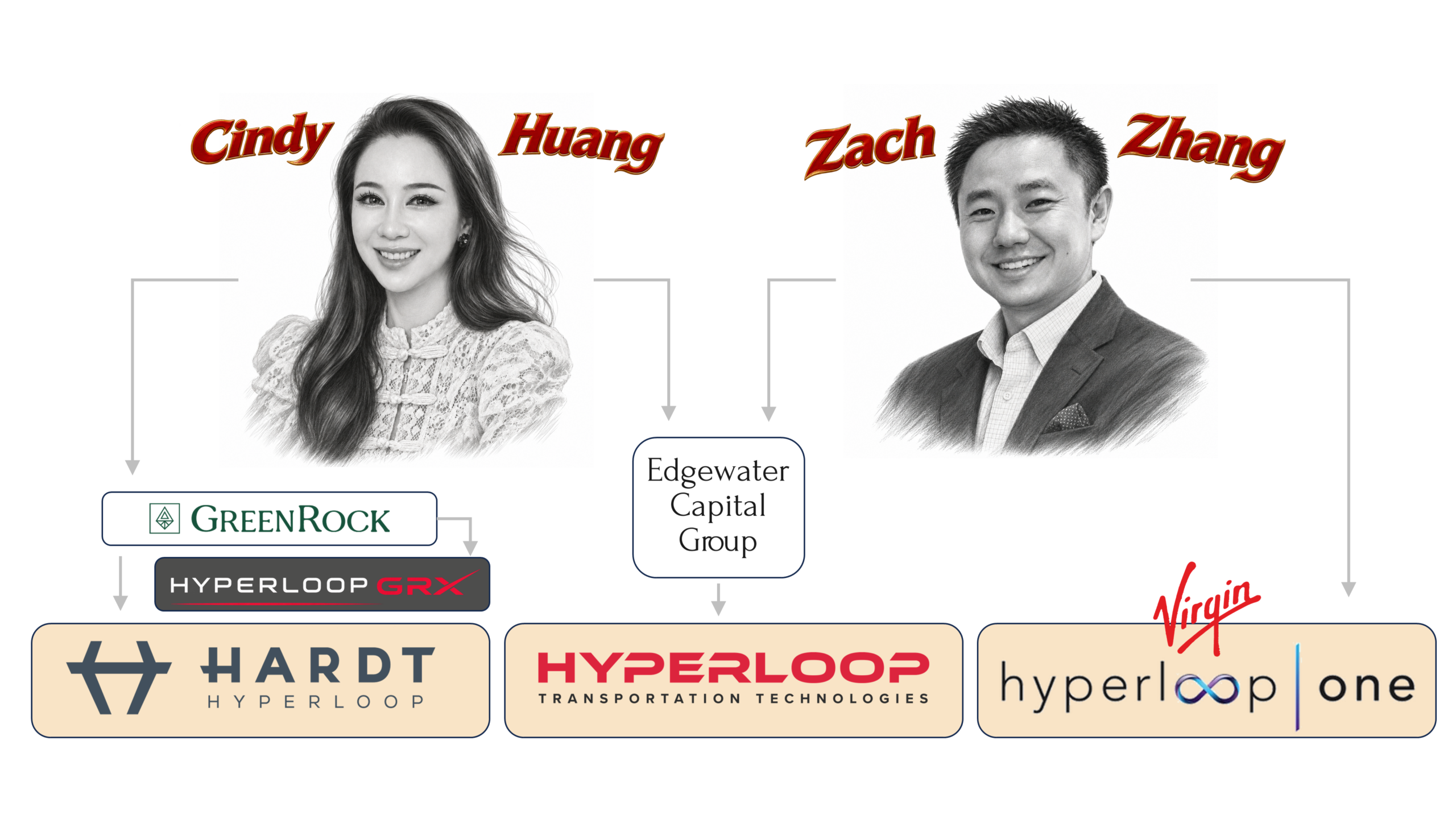
The saviour of the Dutch company was the American investment team called Green Rock Investment, led by the CEO and Founder, Cindy Huang. The first bit of disappointment came when it became clear that the Hardt Group consisted of two companies: Hardt B.V., which did the actual development, and Hardt IP B.V., which was the vehicle for keeping the hyperloop intellectual property. What got saved was the intellectual property arm, not the building one. So, it looks like no Dutch hyperloop construction is to come in the immediate future.
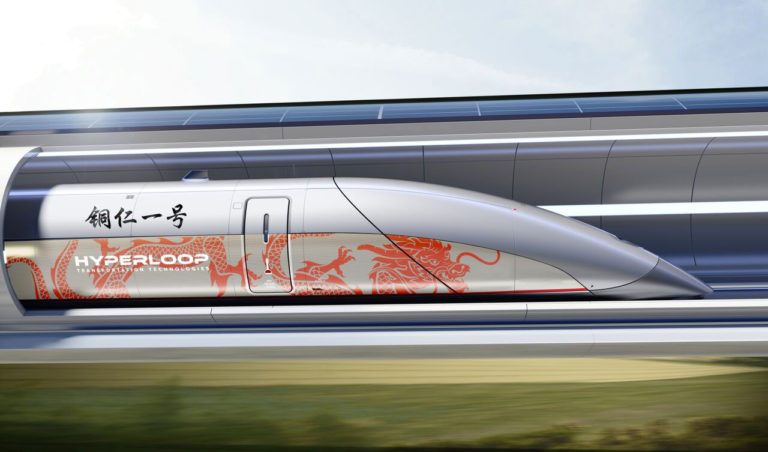
However, the most interesting part was that Cindy Huang had already appeared in hyperloop-related news earlier. Together with her business partner Zach Zhang, Cindy was and remains a co-founder of the Edgewater Capital Group, which provided investments into a completely different hyperloop company – HyperloopTT – back in 2016. HyperloopTT also ceased most of its operations by 2024, remaining a nominal holder of the resulting IP. Its co-founders – Dirk Ahlborn and Bibop Gresta – were distanced from the company in 2019. It looks like, despite the failure of HyperloopTT, Huang maintained a surprising level of enthusiasm toward hyperloop technology, which inspired her to repeat a multi-million-dollar commitment to it again in 2026.
Moreover, during the heyday of HyperloopTT, its main competitor was an American company called Hyperloop One, which, after being saved from bankruptcy by the billionaire Richard Branson, assumed his brand, becoming Virgin Hyperloop. An SEC filing shows that Cindy Huang’s business partner, Zach Zhang, was among the investors of that very Hyperloop One. Hyperloop One stopped most of its operations by 2023 after Virgin pulled out of it.
Thus, the two founders of Edgewater – Cindy Huang and Zach Zhang – connected the top three hyperloop companies, each of which was considered the leader of the hyperloop market at a particular moment in time. All three companies eventually failed. All three companies continue to exist as shell entities that maintain some IP and brand (although most of the IP from Hyperloop One was transferred to its Emirati investor, DP World). That is some impressive level of dedication by the Edgewater duo to various attempts at hyperloop solutions, despite continuing failures.
Both Huang and Zhang came from somewhat typical banking and asset management careers in the West, at places like Citi, HSBC, and Franklin Templeton. However, both later showed a connection to the Chinese government at the highest level. Cindy Huang headed the California State Friendship Committee, which organized and financed the visit of the US Congressman Lou Correa to China, where he met with the Chinese Vice Premier He Lifeng, a member of the Communist Party Politburo, and other senior Chinese legislators. Zach Zhang was a member of the official Chinese business delegation to Russia linked to the New Silk Road – One Belt One Road Initiative, which has strategic importance to the Chinese government. And in 2017, Zhang personally signed the agreement selling $5 million worth of HyperloopTT shares to LEO Middle East FZE in Hong Kong, whose chairman, Wang Xiangrong, was a Chinese political operative in Zhejiang province, the fourth-largest Chinese regional economy.
Finally, in 2026, Cindy Huang created the fourth hyperloop company in this network – Hyperloop GRX – with herself as CEO and three former HyperloopTT contributors as its operatives. Hyperloop GRX is positioned as a platform to manage hyperloop projects going forward.
So, what is going on here? This is where we venture into the realm of educated guesses. On the one hand, it looks like a typical IP play. Investors with Chinese government connections aim to secure access to any intellectual property related to hyperloop development. In this case, the goal would be to transfer hyperloop know-how to relevant Chinese counterparts.
It is worth mentioning that when it comes to China, there are two competing hyperloop projects that have been successfully moving forward for quite a while: one led by the Chinese “aerospace guys”, and the other led by the Chinese “railroad guys”. The aerospace guys – China Aerospace Science and Industry Corporation, known as CASIC – are already testing a 2 km track near Datong in Shanxi province, colloquially known as T-Flight. Its technology implies potential future applicability to space launches. The railroad guys – researchers at Southwest Jiaotong University – are building a 1.6 km test track for the so-called “hot maglev” that may allow speeds of up to 1500 km/hr, referred to as Super-Maglev.
In all honesty, neither of those Chinese hyperloop approaches is easily compatible with the solutions of the described Western counterparts. Chinese projects are also more ambitious and potentially more technologically advanced. Thus, it is hard to estimate how much of the Western IP could be really useful to the Chinese hyperloop companies. On top of that, it is an open question whether investors really had access to full hyperloop documentation of the defunct hyperloop companies.
However, there is a second possibility. Both T-Flight and Super-Maglev are grandiose projects. In essence, they establish a blueprint for a global hyperloop network. If they are used only in China while Europe chooses a completely different approach, the growth potential of the Chinese networks across Eurasia may become stalled. This is especially true since the Chinese hyperloop uses a more expensive and complicated approach of placing propulsion coils (T-Flight) or a permanent-magnet guideway (Super-Maglev) along the entirety of hyperloop tubes, making construction both demanding and costly. For comparison, the Swiss-American company Swisspod places all the complex equipment onto the pods themselves, leaving the tube simple and inexpensive. This means that, regardless of who wins the competition within China, a potential competitor in Europe may eventually outbuild the Chinese counterparts due to simpler construction requirements.
This leaves us with a more interesting option: perhaps the main goal of the network built by Cindy Huang, Zach Zhang, and their Chinese clients is not so much technology transfer from the West to China (which probably does happen), but rather the other way around – making sure that when the hyperloop is eventually built in Europe, it is built according to Chinese blueprints, or at the very least compatible with them. In this case, the technology of HyperloopTT, Hyperloop One, and Hardt Hyperloop has only incremental value – as well as its management. What is more important is to maintain a flame of existence in the controlled Western companies and use them as authentic hyperloop contractors when European government financing finally arrives.